
Shingleback Lizard
Tiliqua rugosa
Also known as: Bobtail · Pinecone Lizard · Sleepy Lizard · Stumpytail
One of Australia's most distinctive lizards — heavily armoured, incredibly slow, and completely harmless. A fascinating reptile found across inland and western NSW.
0428 458 856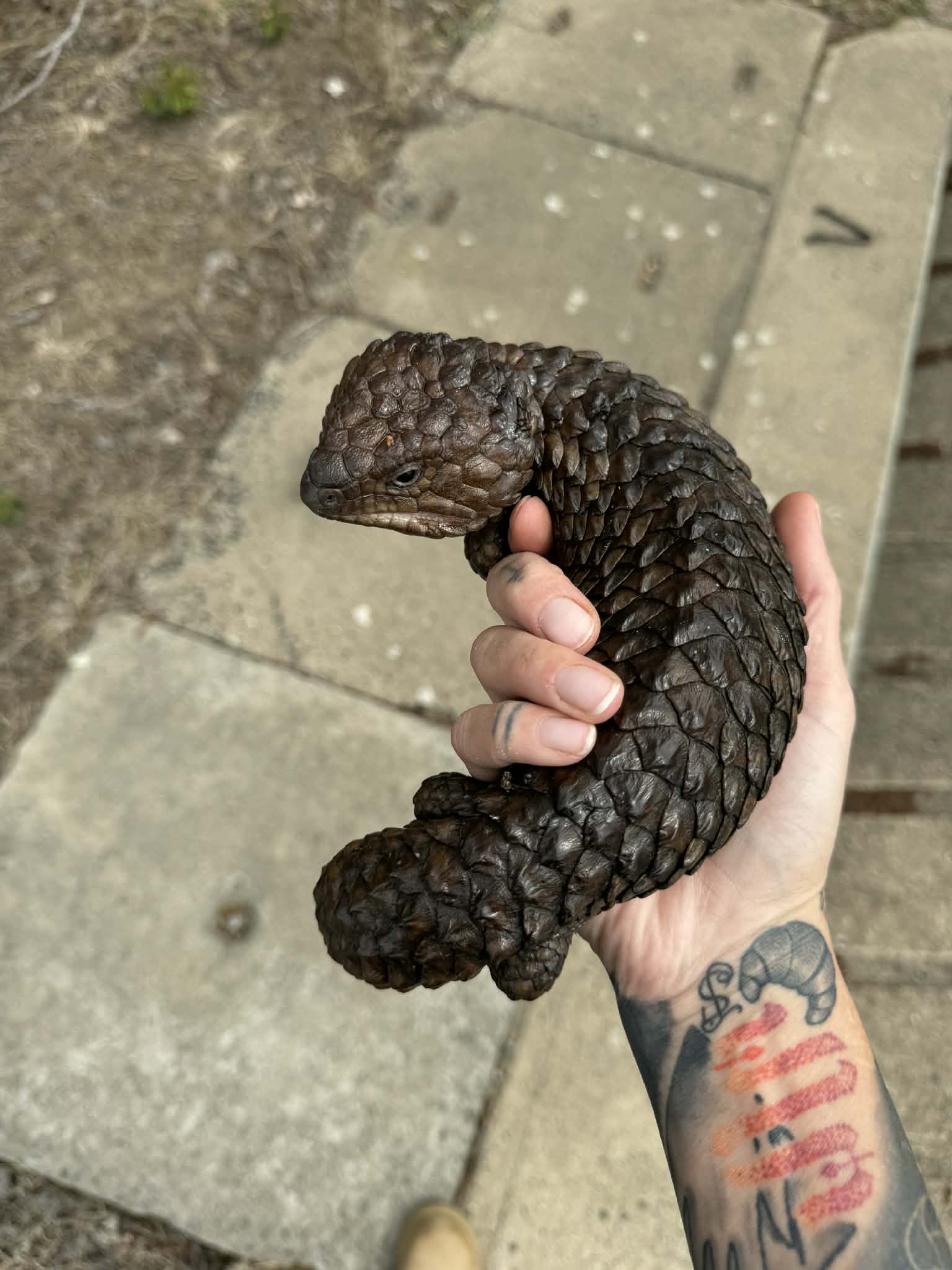
Scientific Name
Tiliqua rugosa
Average Length
30 – 40 cm
Danger to Humans
Harmless
Activity
Diurnal (daytime)
Identification
- Colour: Dark brown to black, sometimes with pale or orange-brown mottling. The rough, keeled scales give a very different texture to most other skinks.
- Size: Adults reach 30–40 cm. Short, stocky, and heavy-bodied — one of the heaviest skinks in the world relative to its length.
- Tail: The most distinctive feature: a short, stumpy tail that is almost the same shape as the head. This confuses predators — it's hard to tell which end is which. Unlike most lizards, the tail cannot be dropped and regrown.
- Scales: Large, overlapping, pine-cone-like scales cover the entire body — rough and armoured in appearance. Completely unlike the smooth scales of most skinks.
- Tongue: Like the Blue-tongued Lizard (a close relative), it has a broad blue tongue used as a warning display.
The stumpy tail is the giveaway — no other NSW lizard has this feature. Shinglebacks are also remarkably slow for a lizard, earning the "Sleepy Lizard" nickname.
Habitat & Distribution in NSW
Shinglebacks are primarily found in drier, open habitats across western and inland NSW:
- Mallee scrubland, dry woodland, and open grassland across inland NSW
- Western slopes and plains — common around Dubbo, Orange, Bathurst, and further west
- Occasionally found in outer suburban areas on the western fringe of Sydney
- Roadside verges and paddocks — commonly seen crossing roads slowly in warm weather
- Often encountered sheltering under rocks, fallen timber, and corrugated iron
Behaviour & Diet
Behaviour
- Extremely slow-moving — relies on armour and bluff rather than speed
- Displays blue tongue and hisses when threatened
- Monogamous — pairs often stay together for life (up to 20+ years)
- Live-bearing — gives birth to 1–4 large, well-developed young
- Basks slowly in open areas on warm days
- Goes into a form of dormancy (brumation) during cold winter months
Diet
- Berries, flowers, and soft vegetation
- Snails and slugs
- Insects and other invertebrates
- Carrion (opportunistically)
- Fungi and plant matter
Is it Dangerous?
Shinglebacks are completely harmless to humans. Despite their fearsome armoured appearance and open-mouth threat display, they cannot cause any meaningful injury. Their bite is weak and they very rarely attempt to bite at all.
- Not venomous — completely safe
- Bite, if it occurs, is weak — no medical risk
- Slow enough that children often pick them up in the wild — still best to leave wild animals undisturbed
- Fully protected under NSW law — cannot be kept, moved, or harmed without a licence
- Major road mortality risk — if you see one crossing a road safely assist it across in the direction it was heading