
Lace Monitor
Varanus varius
Also known as: Goanna
Australia's second-largest lizard and one of its most impressive — a true apex predator in miniature. Powerful, mildly venomous, and fully protected under NSW law.
0428 458 856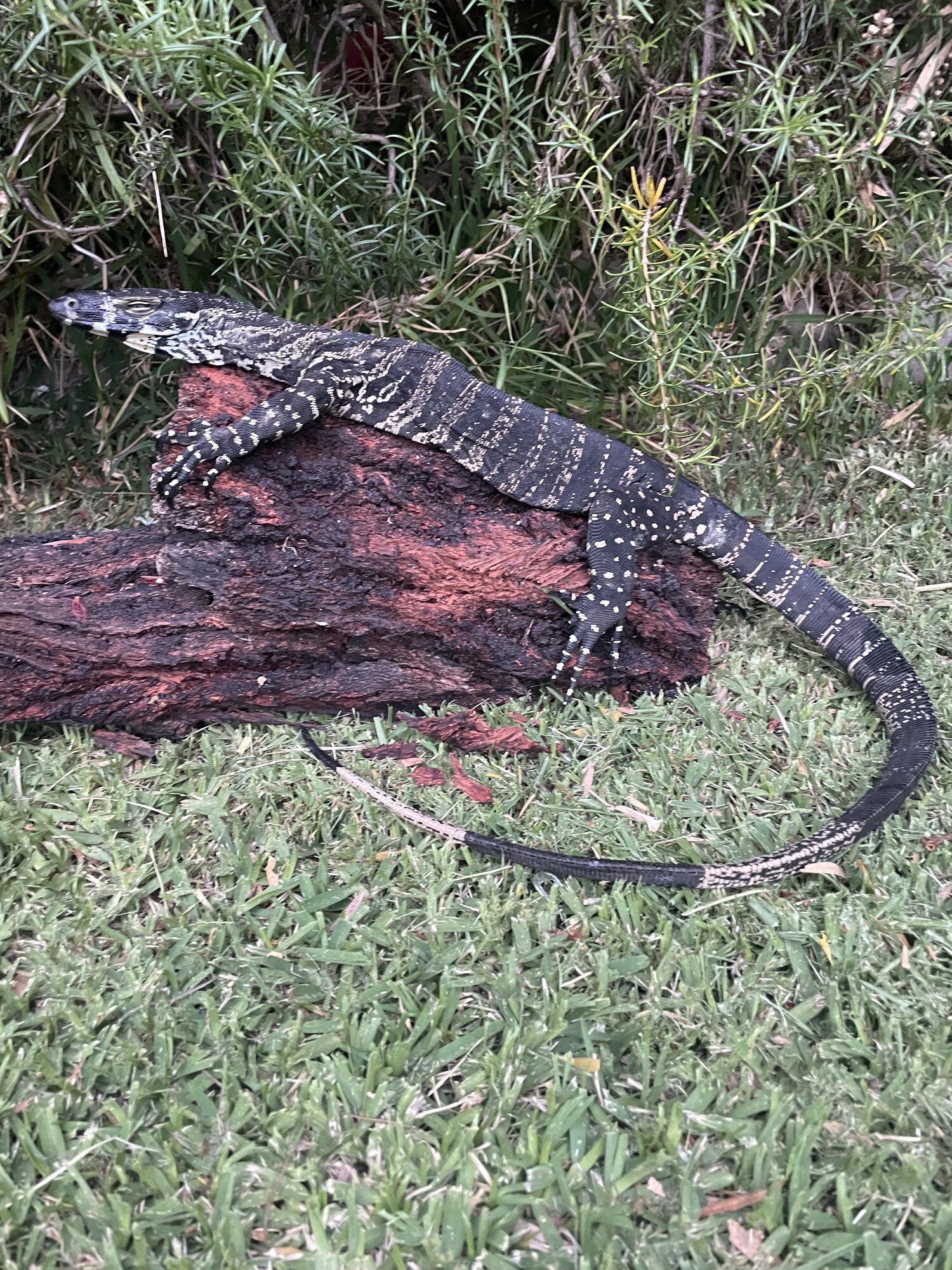
Scientific Name
Varanus varius
Average Length
1.5 – 2 m
Venom
Mildly venomous
Activity
Diurnal (daytime)
Identification
- Colour: Dark blue-black body with distinctive cream or yellow spots and blotches forming a lace-like pattern — giving the species its name. The tail is banded with alternating dark and pale rings.
- Size: Australia's second-largest lizard. Adults typically 1.5–2 metres total length; large males may exceed 2 metres and weigh 14+ kg.
- Head: Long, narrow head with a forked tongue used to detect scent, like a snake. Powerful jaws and teeth designed for tearing flesh.
- Tail: Long, muscular tail used as a defensive whip — can deliver a painful lash. Laterally compressed, aiding swimming.
- Limbs: Strong, muscular legs with powerful claws well-suited to climbing trees. Will scale trees readily when threatened.
Lace Monitors are powerful animals. Never approach, corner, or attempt to handle one. If a large goanna is on your property, keep pets and children away and call us.
Habitat & Distribution in NSW
Lace Monitors are found throughout coastal and sub-coastal NSW, extending into the tablelands:
- Coastal and sub-coastal bushland, forest, and woodland throughout NSW
- National parks across the state — extremely common in Royal National Park, Ku-ring-gai Chase, and Blue Mountains
- Suburban bushland margins — increasingly encountered in garden suburbs near national parks
- Beaches and coastal heath — will forage along the shoreline
- Common throughout the Hunter Valley, Illawarra, and Central Coast
Behaviour & Diet
Behaviour
- Active forager — constantly flicking tongue to detect food
- Climbs trees readily — often roosts and nests in tree hollows and termite mounds
- Capable swimmer
- When threatened, stands upright, inflates throat, hisses, and lashes tail
- Egg-laying — females lay 6–12 eggs, sometimes inside active termite mounds
- Home range can cover many hectares
Diet
- Carrion (dead animals) — a key scavenger role in the ecosystem
- Eggs (bird, reptile, and even snake eggs)
- Small mammals, possums, and rabbits
- Birds and bird chicks
- Snakes and other lizards
- Insects, frogs, and invertebrates
Is it Dangerous?
Lace Monitors are mildly venomous and should be treated with respect. They are not typically aggressive toward humans, but they are powerful animals capable of causing injury if cornered or provoked:
- Mildly venomous — saliva contains venom that can cause significant swelling and local tissue damage if bitten. Bites should be treated medically.
- Claws are sharp and powerful — scratches from large individuals can require stitches
- Tail can deliver a painful lashing blow
- Predators of cats, chickens, and small dogs — keep pets secured when a goanna is present
- Fully protected under NSW law — illegal to harm, kill, or keep without a licence
- Never corner a goanna — they may run toward you to escape (they climb — not charge)