
Eastern Water Dragon
Intellagama lesueurii lesueurii
Sydney's iconic waterway lizard — dramatic in appearance, completely harmless, and found at nearly every creek and river in the region.
0428 458 856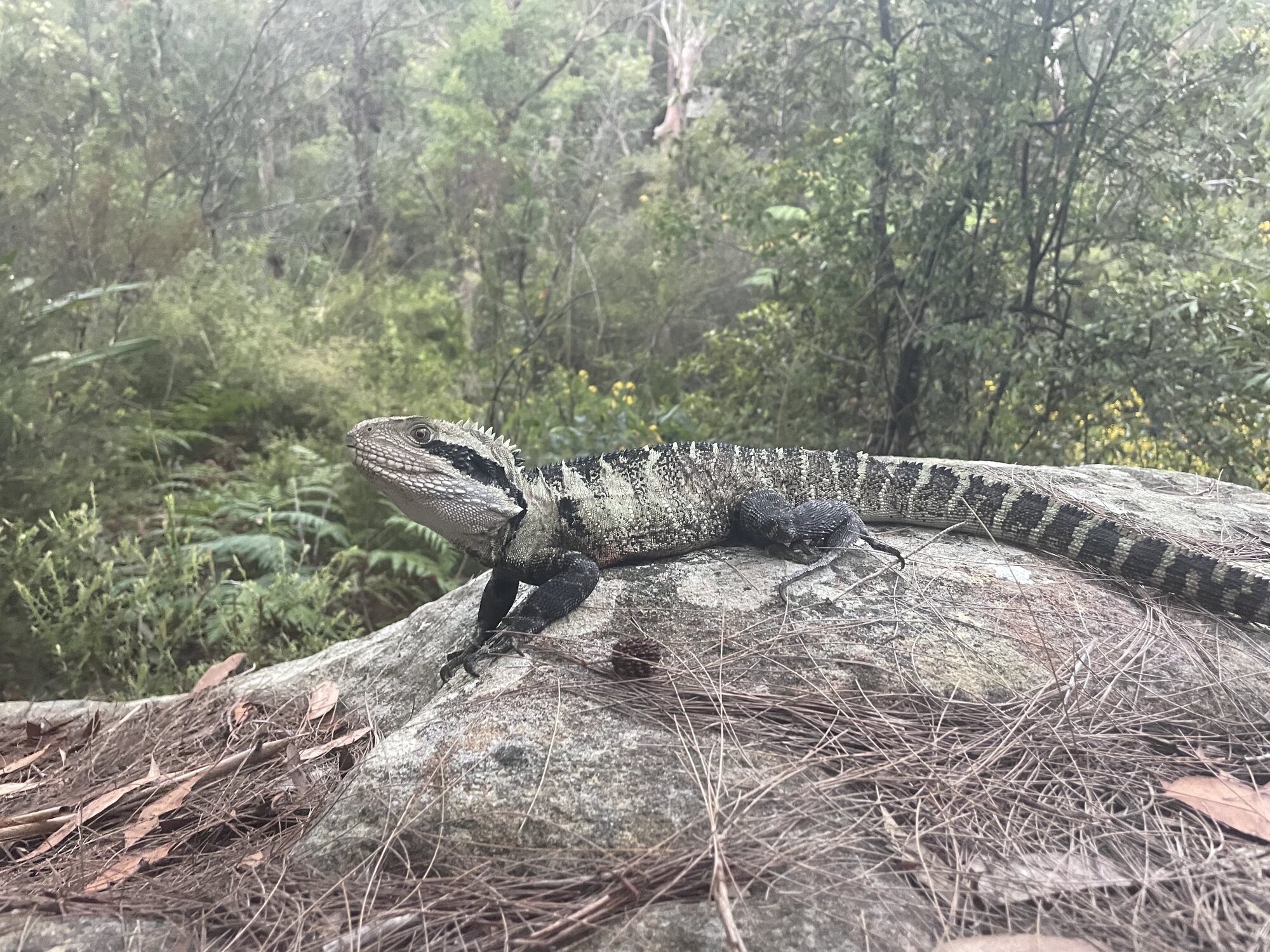
Scientific Name
Intellagama lesueurii
Average Length
60 – 90 cm (incl. tail)
Danger to Humans
Harmless
Activity
Diurnal (daytime)
Identification
- Colour: Grey-green to olive brown body with a distinctive reddish-pink or orange chest and belly in adult males. Bold striping on the sides of the head.
- Size: Adults reach 60–90 cm total length, with the tail making up most of this. Body length is typically 25–30 cm.
- Crest: A spiny crest runs from the back of the head along the spine — more prominent in males.
- Limbs: Long, powerful limbs and claws suited to climbing trees and rocks. Can stand upright on hind legs briefly.
- Tail: Very long, laterally flattened tail used as a rudder when swimming. Can drop and regrow the tail (autotomy) if grabbed by a predator.
Eastern Water Dragons are remarkably calm around humans in parkland settings. They are commonly seen basking on rocks beside streams in Sydney's parks and reserves.
Habitat & Distribution in NSW
Eastern Water Dragons are strongly associated with waterways and are found throughout coastal NSW and into Queensland:
- Riverbanks, creeks, streams, and lake edges throughout Greater Sydney
- Centennial Park, Lane Cove River, Parramatta River, and most urban waterways
- Royal Botanic Gardens Sydney — abundant and very approachable
- Coastal bushland, rainforest edges, and escarpment streams
- Increasingly seen in suburban gardens near waterways
Behaviour & Diet
Behaviour
- Strong swimmer — dives into water when threatened and can stay submerged for 90+ minutes
- Basks on rocks, logs, and branches beside waterways
- Males are territorial — display with head-bobbing and push-ups
- Egg-laying (oviparous) — females lay 6–18 eggs in a burrow
- Partially hibernate during cold months in southern parts of range
- Highly intelligent — become accustomed to humans in parkland
Diet
- Insects and invertebrates
- Frogs and tadpoles
- Small fish
- Yabbies and other crustaceans
- Berries, flowers, and soft plant matter
- Hatchling birds and small lizards (occasionally)
Is it Dangerous?
Eastern Water Dragons are completely harmless to humans. They are non-venomous and their first instinct is always to flee — usually into water. They may scratch or bite if handled, but this poses no medical risk.
- Not venomous — no risk of envenomation
- Prefer to flee rather than stand their ground
- May scratch with claws or bite if cornered or handled — treat as you would any wild animal
- Fully protected under NSW law — cannot be kept, moved, or harmed without a licence