
Harmless — Protected Species
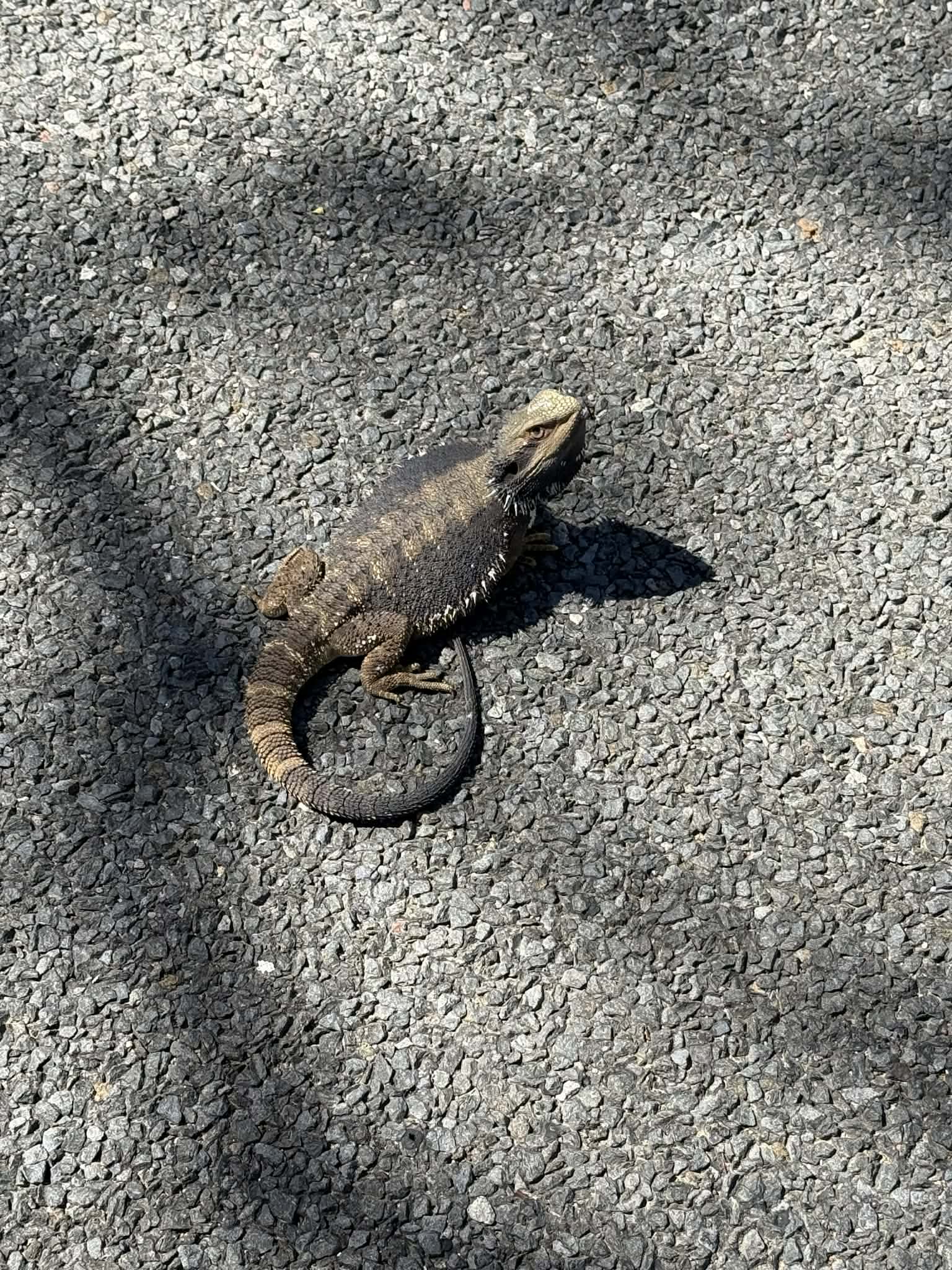
Eastern Bearded Dragon
Pogona barbata
One of Australia's most impressive lizards — a large, prehistoric-looking dragon found across eastern NSW. Despite its fierce appearance, it is completely harmless.
0428 458 856Available 24 hours · 7 days · Public holidays
NPWS Licensed
5.0 · 47 Reviews
Scientific Name
Pogona barbata
Average Length
40 – 60 cm
Danger to Humans
Harmless
Activity
Diurnal (daytime)
Identification
- Colour: Grey, brown, or olive with patterned markings across the back. The beard is dark — often turns jet black when the lizard is displaying threat behaviour.
- Size: Adults reach 40–60 cm in total length. Robust, flat-bodied, and heavy-set for a lizard of this size.
- Beard: The distinctive spiny throat pouch (beard) is used in display — flared and darkened when threatened or during courtship. Both sexes have it; males display more dramatically.
- Spines: Rows of spiny scales along the sides of the body and around the head give it a dramatic, almost armoured appearance.
- Head: Large, triangular head with a wide mouth. Very different in shape from any NSW snake — impossible to confuse.
Wild Eastern Bearded Dragons are often seen perched on fence posts, letterboxes, branches, and rocks — anywhere with a good view of their territory.
Habitat & Distribution in NSW
The Eastern Bearded Dragon is found across most of eastern NSW, from the coast to the inland slopes:
- Open woodland, scrubland, and grassland across coastal and inland NSW
- Suburban areas with trees, fences, and open ground — increasingly common in gardens
- Commonly seen on fence posts, powerlines, rooftops, and letterboxes
- Western Sydney, Hawkesbury, Blue Mountains foothills, Hunter Valley, and Central West
- Absent from dense rainforest and alpine areas
Behaviour & Diet
Behaviour
- Highly visible basker — spends long periods in exposed elevated spots
- Arm-waving: submissive individuals (often females/juveniles) wave one arm slowly as a signal
- Beard display: darkened throat pouch used for threat and courtship displays
- Egg-laying — lays 10–35 eggs in a burrow
- Semi-arboreal — climbs trees and shrubs readily
- Can tolerate surprisingly cold temperatures for a reptile
Diet
- Insects (grasshoppers, beetles, ants)
- Flowers, leaves, and shoots
- Berries and soft fruit
- Small lizards
- Occasionally small mice
Is it Dangerous?
Eastern Bearded Dragons look fierce but are completely harmless to humans. Despite the dramatic beard display and open-mouth threat posture, they very rarely bite, and when they do it barely registers as a nip.
- Not venomous
- Very rarely bites — beard display is almost always a bluff
- Cannot cause injury to adults
- Wild bearded dragons are fully protected under NSW law — illegal to keep without a licence
- Do not confuse with the Inland Bearded Dragon (Pogona vitticeps) — that is a different species kept commonly as a pet